
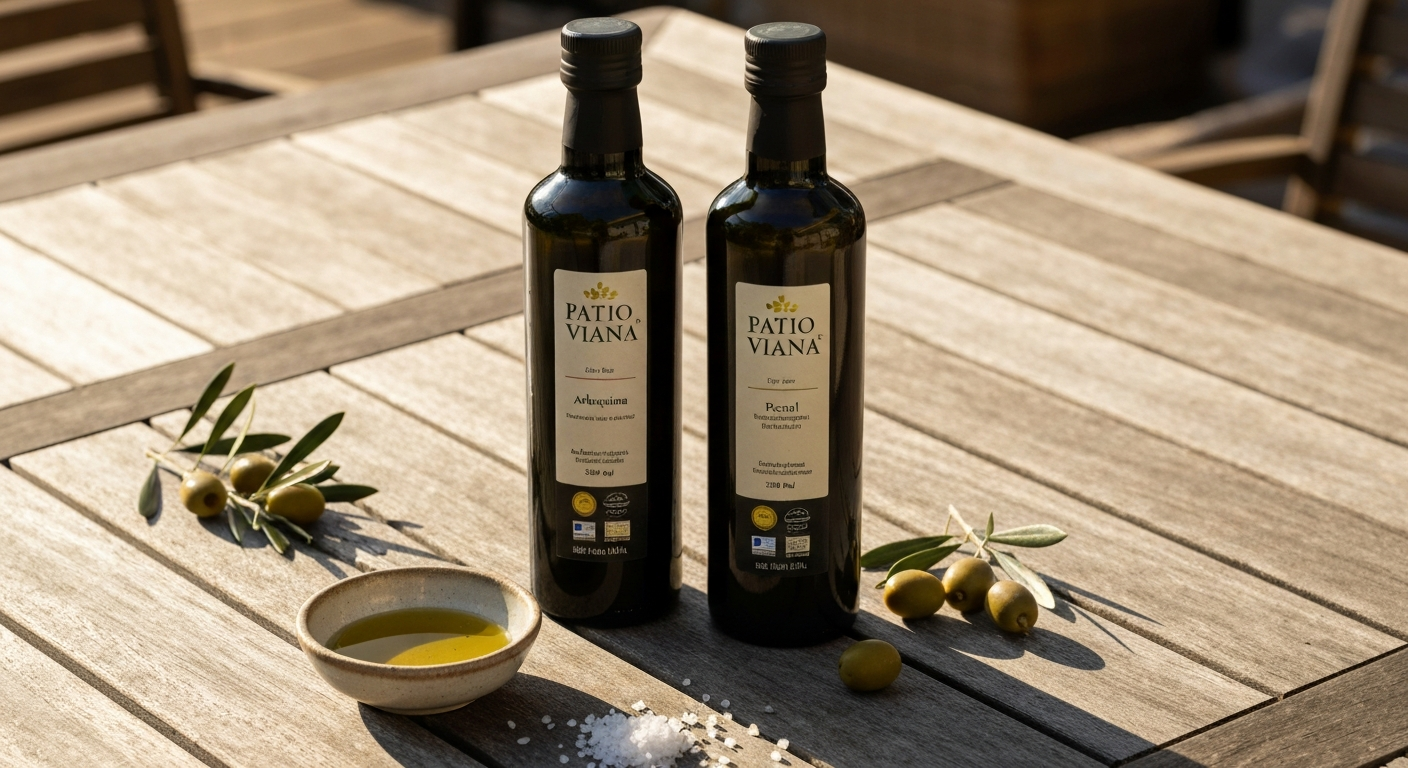
Patio de Viana is a Spanish extra-virgin olive oil produced from Arbequina and Picual olives grown in Jaén, Andalucía, bottled in 250 ml and 500 ml formats, and priced around $24.98 retail in the U.S. or roughly €10.85 in Spain. It is worth buying for patio kitchens and home tables alike: the Arbequina is gentle enough for delicate salads and bread service, while the Picual brings enough green intensity to hold its own over grilled dishes and seasonal patio mains.
Patio de Viana Olive Oil Review: Taste, Use & Buying Guide

Jonah Lawson
29 Jul 2026
Why This Review Matters for Patio Diners and Venue Operators
Outdoor dining has its own logic. Flavors hit differently in open air, sauces get pushed around by a breeze, and anything too aggressive or too bland disappears entirely. The finishing oil a patio kitchen chooses quietly shapes almost every dish that lands on the table, from the bread basket that greets guests to the grilled vegetables that close the meal. Yet most patio menus never name their olive oil, and most diners never think to ask. That gap is exactly what this review is designed to close.
Patio de Viana caught my attention partly because of its name (hard to ignore when you run a site built around patio culture) and partly because it kept showing up in distributor catalogs and specialty import shops alongside genuinely serious Spanish EVOOs. I wanted to know whether the product behind the name could actually hold its own at a busy outdoor table in July, or whether it was mostly aesthetic branding. After working through both the Arbequina and Picual SKUs across a range of outdoor-dining scenarios, I have a clear answer.
Quick Verdict: Is Patio de Viana Worth It for Patios?
Yes, with the right varietal matched to the right dish. Patio de Viana delivers genuine extra-virgin quality at an accessible price point, and its two monovarietal SKUs give patio kitchens a meaningful choice between delicate and assertive flavor profiles. The Arbequina is the safer, more versatile workhorse; the Picual is the better pick when you want the oil to actually be noticed. Neither SKU overreaches, and both are honest representations of Jaén olive oil at this price tier.
Product Snapshot: What You Are Actually Buying
The brand name is PATIO DE VIANA, and the trademark is held in U. U.S. filings list SIMPLY SPANISH PRODUCT, S.L. as the trademark owner for PATIO DE VIANA (blank" rel="noopener noreferrer">PATIO DE VIANA - Trademark Application (Justia Trademarks)). S. filings by Simply Spanish Product, S.L. The oil itself is produced in connection with Cortijo de La Loma S. Industry listings such as EVOO World Ranking of Brands 2026, Olivendo (Patio de Viana / Cortijo de La Loma entries) list Patio de Viana as associated with producer Cortijo de La Loma S.L blank" rel="noopener noreferrer">EVOO World Ranking of Brands 2026 — Olivendo (Patio de Viana / Cortijo de La Loma entries). L. (also referenced in competition entries as Almazara La Loma), a producer based in Jaén, Andalucía, the province that accounts for the largest share of Spain's olive oil output. Both SKUs carry extra-virgin classification, meaning they are cold-pressed and unrefined, with free acidity at or below 0.8 percent per EU and IOC standards.
| Attribute | Arbequina SKU | Picual SKU |
|---|---|---|
| Classification | Extra Virgin Olive Oil (EVOO) | Extra Virgin Olive Oil (EVOO) |
| Olive Variety | Arbequina (monovarietal) | Picual (monovarietal) |
| Origin | Jaén, Andalucía, Spain | Jaén, Andalucía, Spain |
| Producer | Cortijo de La Loma S.L. / Almazara La Loma | Cortijo de La Loma S.L. / Almazara La Loma |
| Trademark Owner (U.S.) | Simply Spanish Product, S.L. | Simply Spanish Product, S.L. |
| Available Sizes | 250 ml, 500 ml | 250 ml, 500 ml |
| Shelf Life | 18 months from bottling | 18 months from bottling |
| Filtration | Filtered (filtrado) | Filtered (filtrado) |
| Intensity | Suave (mild) | Alta (robust) |
The line is described in retailer listings as an 'Autumn Harvest' or 'Cosecha de Otoño' oil, which signals early-to-mid harvest timing rather than a late ripe-fruit pressing. That harvesting window typically produces oils with more polyphenols, greener aroma, and longer oxidative stability, all of which matter when oil sits on a warm patio table for an extended dinner service.
Sensory Tasting Notes and What to Cook With Each Variety
Arbequina: Soft, Fruity, and Immediately Approachable
The Arbequina opens with a delicate aroma that retailers and distributors consistently describe as 'balanced and harmonious,' with notes of sweet ripe olives, banana, red apple, and a hint of almond. On the palate it is smooth and low in bitterness, with a gentle, almost creamy mouthfeel. The finish is short and clean, with very little peppery kick at the back of the throat. That mildness is a feature, not a weakness, when you need an oil that enhances without competing.
Culinary sweet spot: soft cheeses, raw vegetable salads, light vinaigrettes, cold seafood dishes, and dipping bread. It also works beautifully drizzled over vanilla-based desserts if you are running a creative patio menu. Think of it as the oil you reach for when the ingredient itself should be the star.
Picual: Green, Assertive, and Built for Heat
The Picual is a different personality entirely. Distributor notes describe it as 'green, fresh and fragrant,' with vegetable-forward aromas including tomato leaf and artichoke. The palate shows a firmer bitterness and a more persistent, peppery finish that lingers pleasantly. Mouthfeel is slightly thicker than the Arbequina, which makes sense given Picual's naturally higher oleic acid content and polyphenol levels. This is the variety that actually improves when it hits a hot grill or a warm cast-iron pan.
Culinary sweet spot: grilled meats, charred vegetables, robust legume dishes, tomato-based sauces, and any dish where you want the oil to be a conscious flavor element rather than a background note. The Picual is also the better choice for a table-side finishing oil on a steak or grilled fish, where its peppery finish adds a layer of complexity that guests will notice and remember.
How Patio de Viana Performs on the Actual Patio
Salads
The Arbequina is genuinely excellent in simple salad dressings. Its low bitterness and fruit-forward profile let greens taste like themselves, and it emulsifies cleanly with a squeeze of lemon or a splash of sherry vinegar. At a patio lunch where the temperature was pushing into the mid-80s, it held up well in a pre-dressed grain salad that sat on the table for about 20 minutes before being finished. The oil did not turn or go rancid-smelling, which is a real concern with cheaper EVOOs on warm days.
Grilled Dishes
The Picual is where things get interesting for a grill-focused patio menu. Picual's high polyphenol content gives it better heat stability than most mild EVOOs, so it can be brushed onto vegetables or fish before hitting the grill without immediate oxidation. As a finishing drizzle over grilled asparagus, lamb chops, or a charred halloumi platter, it adds a distinctive green-peppery note that genuinely elevates the dish. I tested it against a generic Spanish blend at the same price point and the difference was noticeable, especially on grilled tomatoes where the Picual's tomato-leaf aroma created a pleasant echo effect.
Bread Service
Bread service is often the first impression a patio makes on guests, and it is a low-effort, high-impact place to use a quality oil. Both SKUs work here, but they create different experiences. The Arbequina in a small dipping bowl with flaky salt reads as approachable and elegant, appropriate for upscale patios or any venue where you want the bread course to feel welcoming rather than challenging. The Picual in the same setup reads as more opinionated, a conversation starter for guests who are into food and want something to discuss. If your patio draws a mix of both, consider offering both in separate small dishes and letting guests choose.
Seasonal Patio Menus
Summer patio menus tend to lean toward cold preparations, citrus-heavy sauces, and lighter proteins, all of which favor the Arbequina. As menus shift into fall and the grill gets heavier use, the Picual becomes the more useful tool. Venues running year-round outdoor programming (heated patios, fire pits, enclosed terraces) can realistically rotate both SKUs seasonally without confusing kitchen staff, since the two formats are visually distinct and the flavor difference is easy to explain in a 30-second staff briefing.
Patio-Specific Pairing and Service Suggestions
One thing patio kitchens consistently underuse is the table-side finishing oil moment. A small ceramic pour bottle of Picual placed next to a grilled dish gives guests agency and adds a tactile, sensory element to the meal that they associate with quality. The cost per service is minimal (a controlled pour of finishing oil runs about 5 to 8 ml per use) and the perceived value is disproportionately high.
- Dressings: Use Arbequina as the base oil in all house vinaigrettes. Its neutral fruitiness works across most flavor profiles without overriding herbs, acids, or emulsifiers.
- Finishing oil at the table: Set out 100 ml ceramic or glass pour bottles of Picual for grilled plates. Label them clearly so guests know what they are using.
- Bread service: Portion 15 to 20 ml of Arbequina per person in small dipping dishes with a pinch of coarse salt. Replenish on request rather than flooding the table upfront.
- Cold dishes and crudo: A thin drizzle of Arbequina over raw fish, burrata, or chilled gazpacho adds sheen and aroma without masking the dish.
- Grilling prep: Brush Picual lightly on vegetables or proteins before grilling. Its higher polyphenol content provides better heat stability than mild blends.
- Seasonal garnish: A thread of Picual over warm soups, roasted legume dishes, or autumn grain bowls makes the dish look finished and adds a distinct flavor note.
- Portioning for tables: Budget approximately 10 to 15 ml per cover for finishing and dipping uses combined. For a 40-cover patio service, a 500 ml bottle serves roughly one full shift of bread and finishing use.
Purchasing Details for Patios and Home Cooks
For home cooks, the 500 ml bottle is the practical choice. At approximately $24.98 at U.S. specialty retailers like La Jamoteca (Miami) and through Chef James' online shop, it is priced toward the upper end of everyday EVOO but squarely within the range where quality holds up. In Spain, the same 500 ml Arbequina lists at €10.85 at Hipercor, which puts the U.S. import price at a reasonable markup for a specialty Spanish oil with distributor overhead. The 250 ml format is useful for gifting or for home cooks who want to try both the Arbequina and Picual before committing to larger quantities.
For patio venues and restaurant operators, Patio de Viana is included in the Fleur d'Olive 2026 distributor catalog, which lists both the Arbequina and Picual as available trade SKUs under the Autumn Harvest line. That distribution channel is the primary pathway for wholesale purchasing in the U.S. market. Operators should contact their Spanish specialty food distributor to confirm current trade pricing, minimum order quantities, and lead times, as import volumes for boutique Spanish oils can fluctuate seasonally. The brand also appears on Spanish gourmet retail platforms, which can serve as a pricing benchmark when negotiating with importers.
| Channel | Format | Price (Approx.) | Availability |
|---|---|---|---|
| La Jamoteca (U.S. retail) | 500 ml Arbequina | $24.98 | In store (Miami) and online |
| Chef James Online Shop (U.S.) | 500 ml Arbequina and Picual | Retail pricing listed on site | Online, ship to U.S. |
| Hipercor (Spain retail) | 500 ml Arbequina | €10.85 | Spain, in store |
| AceiteDelCampo (Spain online) | 250 ml and 500 ml | Listed on site | Spain, ships within EU |
| Fleur d'Olive Distributor (U.S. trade) | 500 ml (trade case) | Contact distributor for wholesale pricing | Trade/wholesale, U.S. |
| Spanish gourmet platforms (various) | 250 ml and 500 ml | Varies by retailer | Online, EU and some international shipping |
At the time of writing, Patio de Viana is not a standard stocking item at mainstream North American grocery chains or big-box retailers. Finding it requires going through specialty importers, Spanish food shops, or online specialty platforms. That limited distribution is actually a selling point for patio venues that want to list an oil guests cannot find at their local supermarket.
Quality, Authenticity and Sustainability: What to Verify Before You Buy
This is the section that matters most for venue operators making a purchasing commitment, and it is also where I want to be transparent about what I can and cannot confirm at this stage. Patio de Viana has competition-entry history (entries in Olive Japan / JOOTA competitions reference Almazara La Loma as the production source), and its filtration, intensity classification, and shelf-life information are clearly stated on retailer product pages. What I cannot independently verify from public sources alone are specific certifications (such as PDO, PGI, or organic status), detailed sustainability practices at the almazara level, or traceability documentation. That does not mean those credentials do not exist; it means you should ask your supplier directly and get it in writing before putting this oil on a menu with associated claims.
Here is a practical checklist of what patio venues and procurement teams should request from their Patio de Viana distributor or supplier before finalizing an order:
- Request a copy of the current chemical analysis certificate (panel test or lab test confirming free acidity, peroxide value, and polyphenol content for the specific harvest lot you are purchasing).
- Ask whether the product carries any EU quality designations such as PDO (Protected Designation of Origin) or PGI (Protected Geographical Indication) for Jaén or Andalucía olive oil.
- Confirm the harvest year and 'best before' date stamped on the bottles in your shipment. Cross-reference with the stated 18-month shelf life from bottling to ensure you have adequate runway.
- Ask the distributor or producer for traceability documentation linking the batch to a specific harvest at Cortijo de La Loma / Almazara La Loma in Jaén.
- Inquire about organic certification status (EU organic logo or equivalent) if your venue markets the oil as organic. Do not assume based on packaging alone.
- Ask whether the producer follows any recognized sustainability frameworks (such as AEMO guidelines or ISCC certification for environmental traceability).
- Confirm that the product is filtered ('filtrado') as stated in retailer descriptions, which supports clarity and shelf stability for open-bottle use in busy patio service.
- Request sample bottles from the current harvest lot before placing a full wholesale order, particularly if you are switching from another oil mid-season.
Image suggestion: A label shot showing the harvest date stamp and any certification logos visible on the bottle shoulder or back label would be the most useful visual here. If sourcing from the producer or distributor, harvest photos from Jaén showing the autumn olive pick would reinforce the provenance story effectively.
How It Compares to Common Patio Oil Alternatives
| Criteria | Patio de Viana Arbequina | Patio de Viana Picual | Generic Spanish Blend EVOO | Italian Light EVOO (mid-range) |
|---|---|---|---|---|
| Flavor intensity | Mild, fruity | Robust, green, peppery | Neutral to mild | Light, buttery |
| Versatility on patio menus | High (salads, bread, cold dishes) | Medium-high (grill, finishing) | High but undifferentiated | High but lacks distinctiveness |
| Heat stability (grilling/cooking) | Moderate | Good (high polyphenols) | Moderate | Moderate |
| Price range (U.S. retail, 500 ml) | ~$24.98 | ~$24.98 | $8–$15 | $12–$20 |
| Competitive differentiation on menu | Yes (named origin, varietal) | Yes (named origin, varietal) | No | Moderate |
| Competition history | Yes (Olive Japan / JOOTA entries) | Yes (Olive Japan / JOOTA entries) | Rarely | Varies |
| Wholesale availability (U.S.) | Via Fleur d'Olive distributor | Via Fleur d'Olive distributor | Wide | Wide |
The honest take: if your patio kitchen is purely cost-driven and the oil is only used in bulk cooking, a generic Spanish blend will get the job done at a lower per-bottle cost. But if you are running a patio where the oil touches the table (bread service, finishing drizzle, visible plate garnish), the extra $10 to $15 per 500 ml bottle buys you a product with a story, a clear origin, a recognizable name, and a flavor profile that guests can actually detect and appreciate. That is a real return on a modest incremental investment.
Pros and Cons for Patio Venues and Home Cooks
- PRO: Two distinct monovarietal SKUs let you match the oil to the dish rather than using a one-size-fits-all blend.
- PRO: Jaén origin with competition entries (Olive Japan / JOOTA) adds credibility and menu storytelling value.
- PRO: Filtered and clearly classified (suave / alta intensity) for kitchen consistency.
- PRO: 18-month shelf life from bottling supports reasonable stock rotation for patio venues.
- PRO: U.S. wholesale access via a recognized distributor catalog (Fleur d'Olive 2026).
- CON: Not widely available at mainstream North American retailers; requires specialty sourcing.
- CON: Retail price (~$24.98 / 500 ml in the U.S.) is higher than everyday blends, which requires buy-in from management for venue use.
- CON: Independent certifications (PDO, organic, sustainability) are not confirmed in publicly available product listings and must be verified with the supplier.
- CON: Small format sizes (250 ml and 500 ml) mean higher per-unit handling for high-volume patio operations compared to larger trade containers.
Storage and Serving Tips for Patio Environments
Olive oil and warm outdoor environments are a combination that requires some attention. The retailer guidance on Patio de Viana is consistent with general EVOO best practice: store in a cool, dark place with the cap firmly closed ('en lugar fresco y oscuro, y tapón cerrado'). For a patio kitchen, this means keeping stock bottles in a temperature-controlled storeroom, not on a sunny prep counter. Once open, a 500 ml bottle used regularly in service should be finished within four to six weeks for optimal flavor.
- Store unopened bottles below 65°F (18°C) away from direct light. A kitchen pantry or climate-controlled storeroom works well.
- Never store near the grill station, fryer, or any heat source. Heat accelerates oxidation and flattens flavor faster than anything else.
- For table-side finishing service, transfer from the 500 ml stock bottle into small 100 ml ceramic or dark glass pour bottles. Refill daily. This also limits oxidation from repeated opening of the main bottle.
- If the oil smells musty, waxy, or like crayons, it has gone rancid. Discard it. Rancid oil does not disappear into the food; it makes everything taste worse.
- In very hot outdoor summer service (temperatures above 95°F / 35°C), consider keeping table-side pour bottles in a shaded insulated holder or returning them to the pass between courses to limit heat exposure.
- Rotate stock using first-in, first-out. Check the best-before stamp on each case and plan orders accordingly to avoid sitting on oil that is approaching the 18-month mark.
Where to Sample It and Your Next Steps
If you are a home cook, the most direct route is through La Jamoteca's Miami locations or their online shop, or through Chef James' online platform if you are ordering to the continental U. For additional consumer perspectives and user impressions, see patio by la pasha reviews for tasting notes and firsthand accounts. S. Both stock the Arbequina 500 ml and in some cases the Picual. For broader context on comparable patio oils and customer impressions, see patio del copal reviews. If you are outside those shipping zones, contacting a Spanish specialty food importer in your region and asking about Fleur d'Olive catalog items is the most reliable wholesale path.
For patio diners wondering whether they have encountered this oil already: it is not yet a fixture at most North American patio restaurants, which actually makes it a useful discovery question to ask your server. If a venue is using it, that is a genuine signal about the kitchen's attention to ingredient sourcing. If you are visiting a Spanish-influenced patio restaurant, a tapas bar with an outdoor terrace, or any venue with a Mediterranean-leaning menu, it is worth asking what oil they use for bread service and finishing. The answer tells you a lot about how seriously the kitchen takes its pantry.
If you are exploring other patio venues with strong culinary identities and outdoor atmospheres, this site covers a range of them across North America. For curated coverage of patio-focused venues and additional recommendations, see Santo Patio Reviews. For a comparative perspective on another patio-focused Spanish oil and how it performs across venues, see our Patio de las Flores reviews. Whether you are drawn to the kind of immersive Spanish-courtyard ambiance that a brand like Patio de Viana evokes, or looking for something more eclectic, venues like Patio by La Pasha, Santo Patio, Patio del Copal, and Patio de las Flores each bring their own distinct approach to outdoor dining culture and are worth exploring alongside any ingredient research you are doing.
The bottom line is simple: Patio de Viana is a legitimate, well-made extra-virgin olive oil from one of Spain's most respected olive-growing regions, available in two useful varietal expressions, with a price point that reflects genuine quality without being inaccessible. For patio venues serious about what touches the table, it earns a spot in the pantry. For home cooks who eat well outdoors and want an oil that rewards attention, it is worth seeking out.
FAQ
What basic product facts should I verify before writing the Patio de Viana review?
Confirm exact brand spelling and trademark owner (PATIO DE VIANA, SIMPLY SPANISH PRODUCT, S.L. per U.S. filing), SKU names (Arbequina, Picual), declared origin/production area (Jaén, Andalucía), extra‑virgin status on label, packaging sizes (250 ml, 500 ml, miniatures), bottling location, and stated shelf‑life/consumo preferente (e.g., 18 months). Cite retailer and trademark pages for each fact.
What authoritative sources establish provenance, producer and ownership?
Primary sources: trademark filings (Justia or government IP offices) for brand owner; producer/distributor sites and catalogs (e.g., Cortijo de La Loma/Palacio Marqués de Viana listings, Fleur d’Olive catalog); retailer product pages (Hipercor, AceiteDelCampo, La Jamoteca) that state harvest/region and bottling. Use these to confirm producer attribution, harvest area (Jaén), and trade packaging details.
Which lab and certification data are necessary to confirm extra‑virgin quality and authenticity?
Request or obtain certified lab analysis and Certificates of Analysis (COA) showing free acidity (% oleic), peroxide value, UV (K232/K270), sensory defect/median fruity scores, and total polyphenols if available. Also seek third‑party certification records (COI/Certificate of Origin, organic certification, PDO/PGI listings) and independent panel tasting results from competitions (e.g., Olive Japan winners list). Cite lab reports and competition pages.
How should I collect trustworthy sensory tasting notes for the review?
Perform blinded tasting(s) following a standard protocol (IOC/USDA/EVOO sensory panel format): pour standard sample temperature, use blue tasting glasses or clear if describing colour, evaluate fruitiness, bitterness, pungency, defects, and aroma descriptors (tomato, artichoke, almond, banana, apple). Record multiple tasters (minimum 3—ideally a trained panel), dates, batch codes, and link tasting notes to the specific SKU and harvest year. Archive photos and tasting forms.
What retail and wholesale purchasing facts are needed for patio operators?
Document pack sizes and formats (bottle types, miniatures, tins), price ranges in local currency across markets (Spain and U.S. specialty retail examples), available wholesale trade packs, minimum order quantities from distributors (Fleur d’Olive catalog), and common retail/wholesale sources (supermarket Hipercor, specialty retailers like La Jamoteca, Chef James, and importers). Note whether patio venues typically stock it and at what markup ranges.
Which sustainability and production‑method claims must be verified?
Verify on‑label and producer claims: organic, sustainable farming, early‑harvest/first cold press, filtered/unfiltered, carbon or water footprint claims. Request producer documentation on farming practices (integrated pest management, harvest timing), milling methods, energy use, and sustainability certifications. Cite producer statements and third‑party audits where available.